This article is part of the ’24-’25 Donor Yearbook & Annual Report. Click here to download the full report (PDF).

Since its founding in 2021, the Redwood Region Climate and Community Resilience Hub has become a catalyst for grassroots climate justice solutions in the HAF+WRCF service region—places too often overlooked in traditional climate planning.
An incubated program of the Foundation, CORE Hub invests in deep community engagement, expert technical and legal assistance, and individual and collective resilience capacity. CORE Hub’s efforts are grounded in the belief that the people most affected by climate change are best suited to solve it.
In the last year, the CORE Hub and its network of partners played a pivotal role in shaping regional policy and infrastructure with equity at the center. This included engaging Tribal leaders, local advocates, legal experts, and environmental scientists to respond to one of the largest proposed industrial developments in the region: the offshore wind industry cluster.
Our Approach
CORE Hub’s mission is to transition to a climate resilient and decarbonized future while prioritizing equity and justice by ensuring benefits accrue to underrepresented, historically and currently marginalized communities first and to the greatest extent.
This work is made possible by generous support from The James Irvine Foundation, The California Endowment, the William & Flora Hewlett Foundation, the S.H. Cowell Foundation, the California Coastal Program of Resources Legacy Fund, and an anonymous funder.
Our Work
CORE Hub focuses on two major areas of work: building and supporting the Tribal Climate Resilience Network composed of ten federally-recognized Tribes in Northern California and engaging with the emerging offshore wind industry through the Offshore Wind Community Benefit Network, convened by CORE Hub. The community benefits network, alongside partners throughout the state, advocates for issues that impact communities along California’s coast.
Some topics CORE Hub and partners advocate for include:
- Respecting Tribal sovereignty and prioritizing Tribal leadership, partnership, and co-management.
- Zero-emission port development along with long-term plans to phase out fossil fuel infrastructure to improve air quality and the life expectancy in surrounding communities.
- Monitor impacts and implement strong mitigation measures to ensure marine and coastal ecosystems/animals thrive during and after offshore wind development and deployment.
- Inclusive workforce practices.
CORE Hub’s roles include convening community and industry members, sharing information, providing technical assistance to partners, making grants to strengthen community decision making and response, advocating for community benefits, engaging with national philanthropic partners, and growing relationships among communities and businesses.
Our Impact
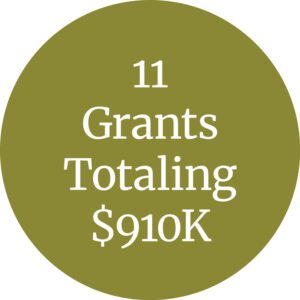
This year, the CORE Hub awarded multiple rounds of grants from its new Tribal Climate Action Fund. The $3.3 million fund provides up to three years of support for federally recognized Tribal nations in the HAF+WRCF service region to address new and emerging climate-related challenges. CORE Hub also gathered members of the Tribal Climate Resilience Network to convene around key priorities and grow a collective understanding around key areas of interest, like energy independence, carbon-mitigating projects, and the need for technical assistance.
Our Reach
Over the past year, CORE Hub advanced climate resilience across the state through efforts such as:
- Supporting regional partners’ participation and engagement in statewide offshore wind dialogue at the Pacific Offshore Wind Conference in Sacramento, a key convening that was focused on the evolving offshore wind sector.
- Convening and strategizing around aligned priorities with communities impacted by potential offshore wind port development in Long Beach.
- Helping state-wide renewable energy advocates understand regional needs by hosting them in the region.
- Shaping state policy by organizing regional response during multiple advocacy opportunities around port development, tribal energy resilience planning, and workforce development.
Grants Support Tribal Climate Resilience Network
Eight Tribes have received a total of $800,000 in grants from the CORE Hub’s inaugural round of funding from the Tribal Climate Action Fund. “These grants support tribal capacity to help them advance their environmental resilience and decarbonization projects,” says Katerina Oskarsson, Executive in Residence for the CORE Hub.
The grants will support projects focused on climate resilience, decarbonization, staff development, and long-term sustainability planning.
TERAS Project Helps Keep Rural and Remote Tribes Connected with Grid Innovations
CORE Hub invested $250,000 in the Tribal Energy Resilience and Sovereignty Project (TERAS) to help improve energy delivery to rural and remote Tribes. TERAS is a collaborative effort led by the Blue Lake Rancheria, Hoopa, and Yurok Tribes, the Schatz Energy Research Center, Pacific Gas & Electric, and the Redwood Coast Energy Authority. It aims to stabilize energy delivery along the 142-mile “Hoopa 1101” corridor, which experiences some of California’s longest and most frequent power outages.
In October 2025, the Federal Administration canceled support for the TERAS project as part of the rescission of $7.5 billion in previously approved funding for green energy projects across the country. The CORE Hub remains committed to supporting Tribal Nations in their efforts to implement sustainable energy projects.